
Walla Walla Heritage Park History Website
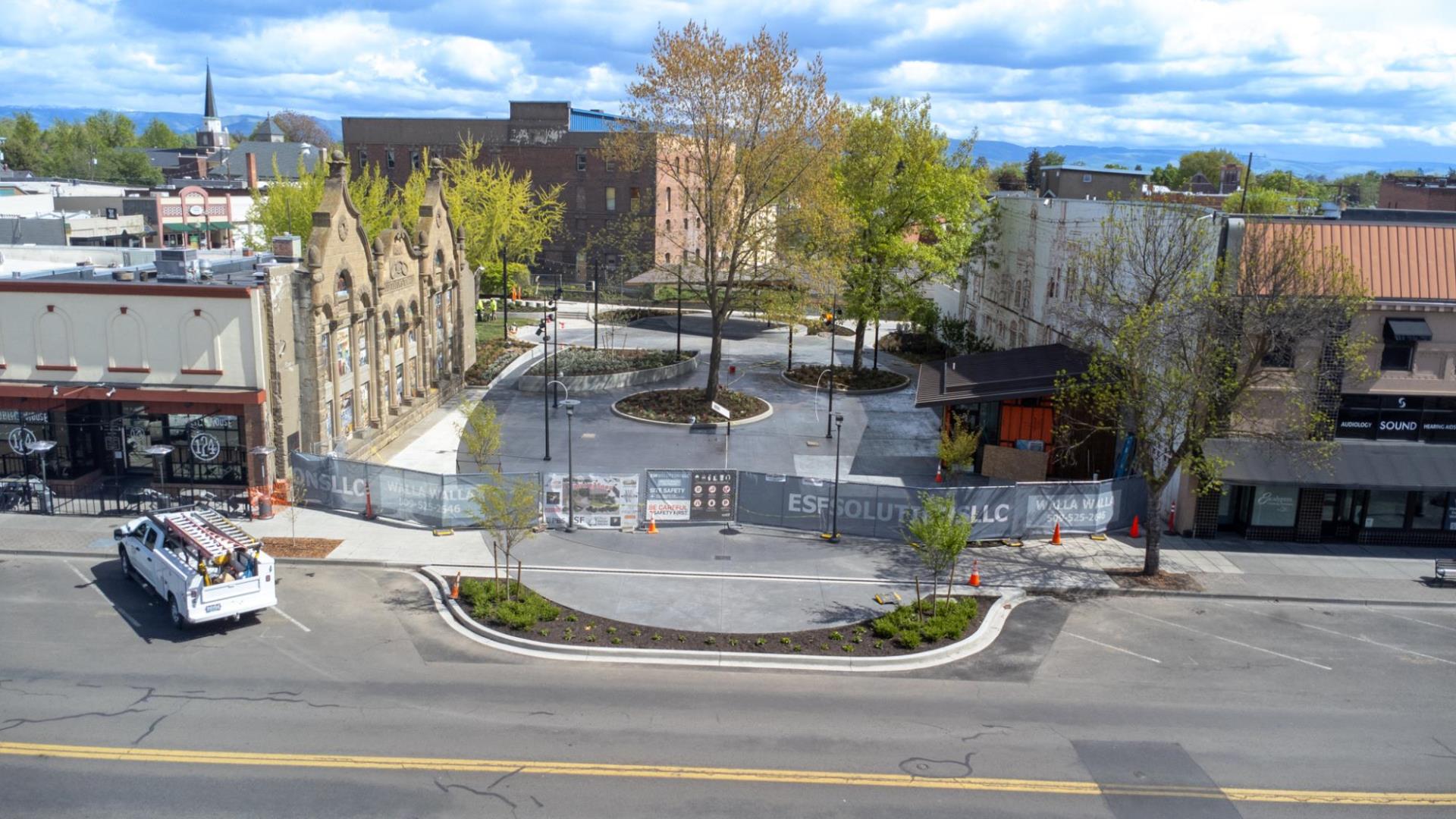
Heritage Park. Photo courtesy City of Walla Walla.
Heritage Park is a newly renovated, centrally located urban park at 116 E Main St in downtown Walla Walla, Washington. Following a $2.6 million renovation completed in 2024, it serves as a premier, accessible community gathering space and venue for local events.
Heritage Park is designed to be a welcoming “pocket park” that blends the city’s history with modern, accessible amenities for residents and visitors.
Key Features and Amenities
-
- Covered Stage: A central feature used for concerts, performances, and public events.
- “Windows on the Past”: A prominent mural featuring historic and contemporary photos of ethnic and cultural groups from the area.
- Accessibility & Facilities: The 2024 renovation added ADA-accessible, year-round restrooms, benches, tables, and a large grass area.
- Location: Situated along the Mill Creek Channel in the heart of downtown.
Events and Activities
-
- Summer Concert Series: The park hosts a weekly series, typically featuring local bands from July through September.
- Community Gatherings: It is used for community events, youth and family programming, and as a downtown focal point.
Walla Walla 2020’s History with Heritage Park
In the fall of 1989, Downtown Foundation director Sheila Ferguson approached Walla Walla 2020 with the idea of developing a community recreation trail through the downtown. She had been talking with Congressman Tom Foley about federal funds to help with the downtown renewal project, and had been told the only possibility of funding would be for a trail project. She asked if we could plan a trail whose major trailhead would be located downtown in order to bring some federal funds there, as well as to upgrade general trail facilities in the community.
Walla Walla 2020 member John Winter and I biked around the community surveying existing bike paths and potential routes, and devised a loop trail from Rooks Park east of Walla Walla out to the Whitman Mission to the west, that included all of the existing bike paths, the cities of Walla Walla and College Place, and all three colleges. Our proposed trail added several new dedicated links, and connected them all with on-road routes and a trailhead park at an abandoned property on the south side of Main Street along Mill Creek in downtown Walla Walla. Some concept of a Rooks Park to Whitman Mission trail had been alive since at least 1976, when Walla Walla County and the cities of Walla Walla and College Place had agreed to jointly seek funding for such a project.
On January 5, 1990, as coordinator of Walla Walla 2020 I drafted a letter describing the project to Tom Foley, then speaker of the US House of Representatives. The letter was also signed by the City of Walla Walla parks director, the planning directors for both the City of College Place and Walla Walla County, the director of the Downtown Foundation, and John as chair of the “Walla Walla Area Recreational Trail Joint Task Force” which we formed in order to pursue the project.
Like any legislative effort, the legislative process went through an enormous number of hoops, but thanks to Tom, in November 1991 it was finally approved as a partnership involving city, state, private, and federal interests, and over $375,000 of federal funds were provided over a three-year period. The state’s share was $100,000 that we obtained from a successful 1990 grant application I presented to the state Interagency Committee for Outdoor Recreation (IAC).
A problem arose with the requested local cash match for our federal grant, which was to come from the downtown renewal project, when at the last minute the City lowered its contribution to that fund, leaving us $100,000 short. Fortunately, I was able to convince four members of the council that the City should come up with the remaining $100,000 out of general city funds, and the project went through.
The community facilities we added through this project included the widening and extension of the recreation trail on the north side of the freeway through an arrangement we made with the state Department of Transportation; the building of a trail from the west end of Chestnut Street to the Fort Walla Walla Amphitheatre, opening a 38-acre undeveloped portion of Fort Walla Walla Park including an irrigation system and tree plantings; and the purchase of property and the development of a trailhead park on Main Street along Mill Creek with a shelter, restrooms, playground equipment, and mural. Though we had also hoped to build new dedicated links of the trail along Mill Creek west of downtown and along Garrison Creek west of Myra Road, we ran into resistance from property owners and that didn’t happen.
The downtown trailhead park property was purchased and developed in 1992 through an arrangement with Rob Robinson, the community-minded construction manager who held a court judgment against the former property owner, and who acquired, developed, and sold the property to the City in a creative deal which made our money stretch further than would otherwise have been possible. In 1994, Rob as president of the Blue Mountain Arts Alliance also arranged for the donation of the façade of the fanciful old Odd Fellows Temple on Alder Street, then led a fundraising campaign for and oversaw the reconstruction of the facade on the east wall of the park.
Other elements of the park include playground equipment and a large mural on the west wall, for which I invited proposals from several artists, out of which came an agreement with Jim Fritz, who was very successful in memorializing the outlines of several historic downtown Walla Walla buildings which had been lost over the years. Other murals were later added to the south wall along Mill Creek by youthful artists.
In 1995, further art was added to the neighborhood when members of the Whitman sorority Kappa Alpha Theta called with an offer to cooperate with Walla Walla 2020 on another community mural. Jim Fritz again helped out, this time with the creation of a transportation mural on the Mill Creek side of the old Naimy Furniture Warehouse building across Spokane Street from the park. The materials costs and some labor were contributed by the Thetas. The resulting mural featuring historic modes of transport can be seen there today.
The final artistic contribution to the park has been the Windows on the Past project led by Rob Robinson and Jeana Garske of the Blue Mountain Arts Alliance, now ArtWalla, and Walla Walla 2020 member Jeanne McMenemy. Windows is a very high-quality memorialization of Walla Walla’s various ethnic groups through a series of color photographs appearing in the windows of the Odd Fellows façade.
Excerpted from A Privileged Life: Memoirs of an Activist by Daniel N. Clark
Additional Resources
Windows on the Past
Located in Heritage Park, this colorful mural is composed of historic and contemporary photos from ethnic and cultural groups who lived in the Walla Walla Valley from 1850-1950. They are reproduced in porcelain enamel on steel panels and inlaid on the historic façade of Henry Osterman‘s 1902 Odd Fellows’ Temple.