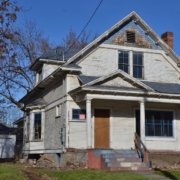
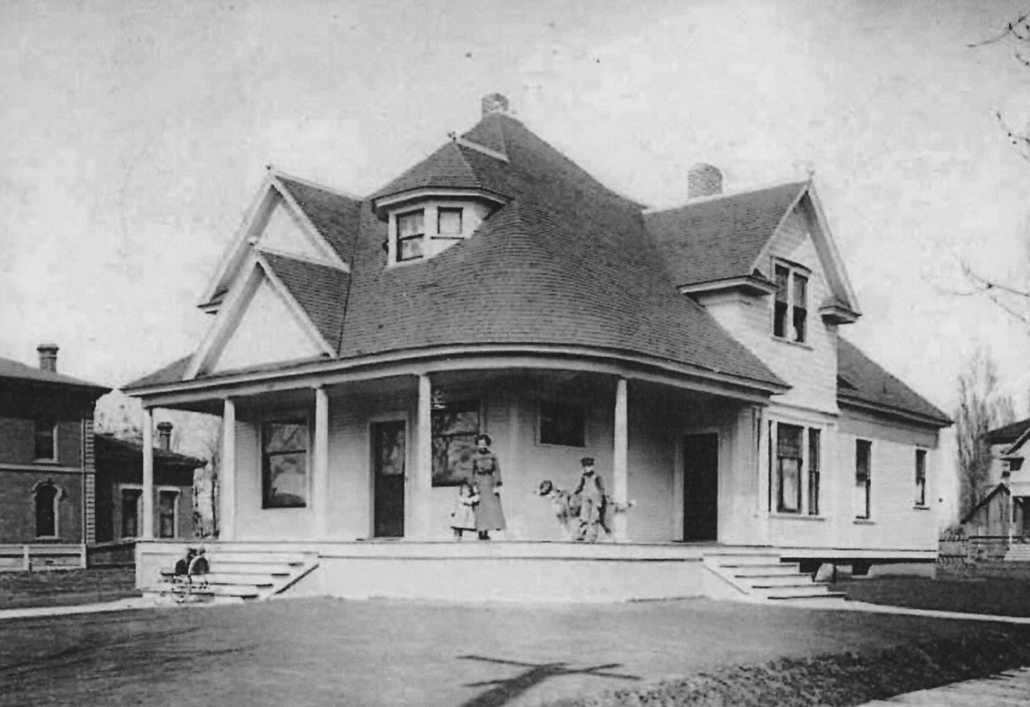
History of 105 East Sumach Street, Walla Walla, WA
Title and Occupant History
Washington Territory was created in 1853. In 1854, the new territorial legislature created Walla Walla County, which stretched from the crest of the Cascade Mountains to the crest of the Rocky Mountains in the present states of Washington, Idaho, and Montana. In 1855, Isaac Stevens, governor of Washington Territory, held a council on the banks of Mill Creek at the present site of Walla Walla with representatives of regional Native tribes to purchase land from them. The Yakama, Cayuse, and Walla Wallas were dissatisfied with the treaties and the intrusion by whites into their lands before the treaties’ ratification, and war followed. Missionaries, former French-Canadian employees of the Hudson’s Bay Company trading post at Wallula, and soldiers at the military Fort Walla Walla were the primary European occupants of the area prior to 1859, when the treaties were finally ratified and the land was opened for settlement. The transfer of ownership occurred by virtue of a treaty signed on June 9, 1855, in Walla Walla and ratified on March 8, 1859, by President James Buchanan, in which all of the land in the Walla Walla area was acquired from the Cayuse and Walla Walla tribes.
The Town of Walla Walla was originally laid out by County Surveyor Hamet Hubbard Case in 1859. In 1862, Walla Walla was formally incorporated as a city one-quarter mile square. Its eastern side was centered on the point where Main Street crossed Mill Creek (at roughly the point it does now). The original plat was lost, probably in the fire of 1865. Thus, the earliest plat on file is one made by W.W. Johnson, City Surveyor, in July 1865, that claims to have made corrections to Case’s survey. Johnson’s survey was made the Official Plat of the City of Walla Walla on September 25, 1866, and was filed and recorded July 5, 1867.
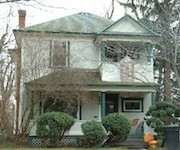
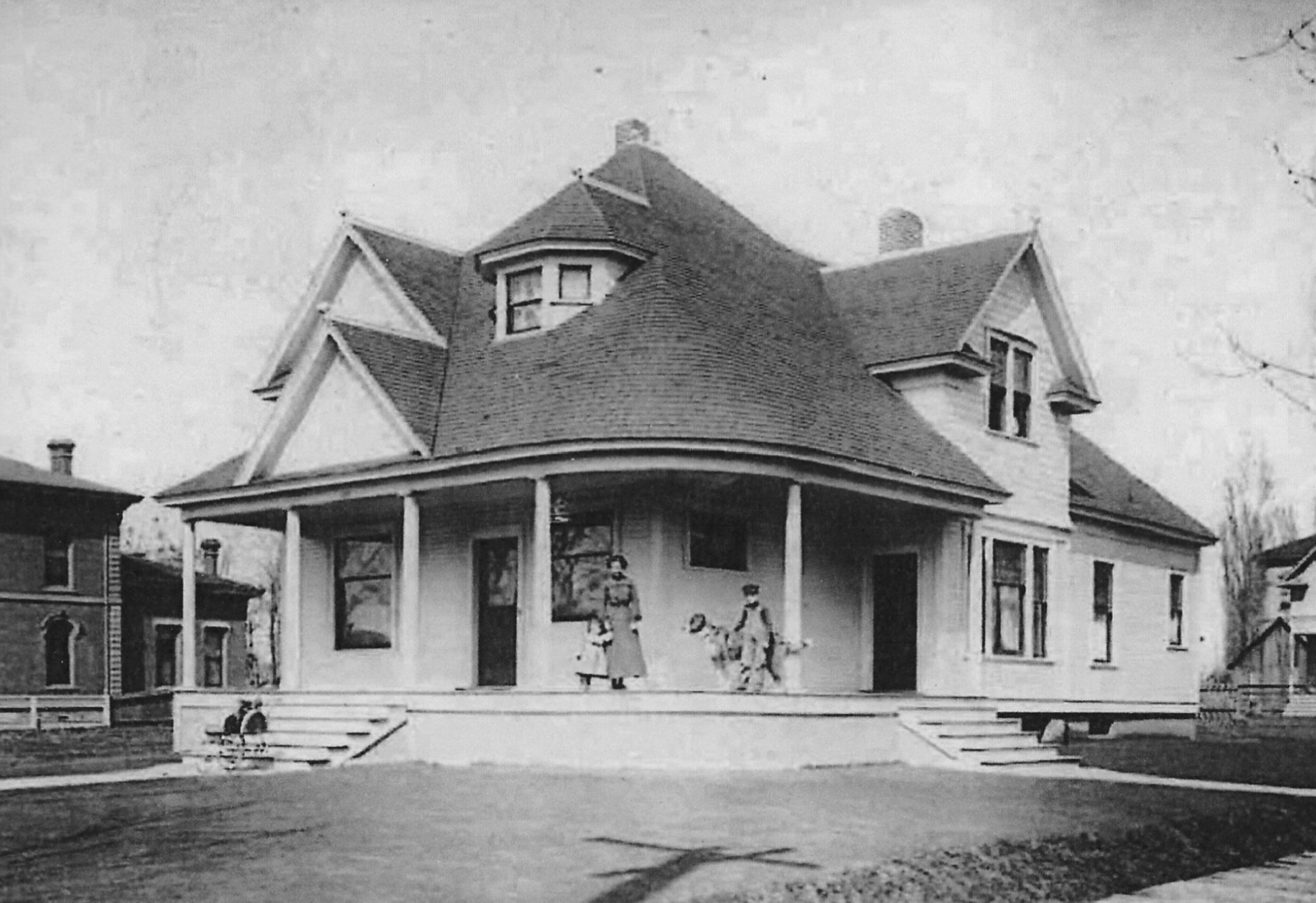
Built circa 1903, members of the William and Isabella Kirkman Family owned this property from 1872 to 1927 when it was transferred to Whitman College. From 1904 to 1927 Allen and Fanny Kirkman Reynolds lived here. Allen was an attorney and served as treasurer and later chair of the Board of Trustees of Whitman College. Their daughter Ruth was the college’s head librarian. Whitman continued to own this house until 1942.
The Reynolds family was an early pioneer family that settled in Walla Walla shortly after Marcus and Narcissa Whitman, and went on to have a large presence in the Walla Walla community for nearly half a century.
Almos Holbrooke Reynolds was born in 1808 and moved to Walla Walla in 1859. He was a prominent businessman in the early pioneer community in Walla Walla. He constructed the first commercial flour mill in the Walla Walla Valley in 1895 and also established the first banking business in Walla Walla. He died in 1889.
Lettice Jane Clark (1830-1911) arrived in the Walla Walla valley after the Whitman mission. She married Almos Holbrooke in 1861 after the death of her first husband, Ransom Clark, a prominent Walla Walla developer. While in Walla Walla, she founded the local chapter of the Young Men’s Christian Association (Y.M.C.A), and Whitman College’s Reynolds Hall is named for her. Together, Lettice and Almos had two sons, Harry Almos Reynolds (1863-1948) and Allen Holbrook Reynolds (1869-1941). Harry Almos served as the secretary for the same Y.M.C.A. chapter his mother founded. Harry Almos and his wife had six children, three of whom remained in Walla Walla into their adulthoods.
Allen Holbrook Reynolds, the second son of Lettice and Almos, was a prominent Walla Walla lawyer, and the partner of the firm Reynolds and Bond, Attorneys at Law. He served as the treasurer and president of Whitman College Board of Trustees. He also served as the president of the local Y.M.C.A.
Allen Holbrook and his wife, Fanny, had Almos Kirkman (1898-1953), Ruth Sarah (1901-1985), and William Allen Reynolds (1895-1967). All three of their children were graduates of Whitman College.
Ruth Sarah Reynolds was the Whitman College librarian from 1926 to 1950 and followed the library from its location at a temporary structure, to Reynolds Hall, to its eventual permanent home in the Penrose Library building. She also started what would later become the Whitman College and Northwest Archives.
In the mid-1970s, the home was known as the “House of Seven Gables”, operated by Lillian Hoffman. Lillian and her son, David, started a furniture and antique restoration service here that later evolved into Adele’s Doll Shop, a doll-restoration “hospital” and class space. The business closed in 1990.
Resources
- Archives West, Reynolds Family Papers
- Vance Orchard, “Doll-making hobby turns into business”, Walla Walla Union Bulletin, March 12, 1982, page 3