
Welcome to the Italian Heritage in the Walla Walla Valley History Website
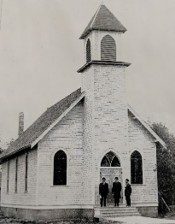
Saint Francis of Assisi Catholic Church, 1915 Church.
Saint Francis of Assisi Catholic Church was established on February 1, 1915, as a language-based “national” parish, primarily to serve Walla Walla’s Italian immigrants. The first pastor, Fr. O. R. Balducci, spoke Italian, as did the pastors who followed him until the late 1940s. According to parish tradition, St. Frances Xavier Cabrini visited Walla Walla on one of her journeys to Seattle in the early 1900s. During this visit, she is said to have encouraged the Italian community to build their own church, as many were not comfortable attending St. Patrick’s at the time. A larger church, still standing today was built in 1939, entirely through donations from parishioners.
The first major wave of Italian immigrants to the area began in the 1870’s and 1880’s, continuing into the 1900’s. It was led by Pasquale Saturno, who established the Southern Italian community, and Guiseppe (Joseph) Tachi who established the Northern Italian community. Both men were prosperous commercial farmers, though there were major differences in their two communities.
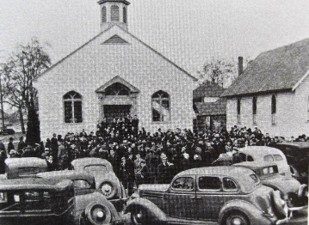
Saint Francis of Assisi Catholic Church, 1939 Church.
Despite their equality in numbers, the Northern and Southern Italians in Walla Walla reflected stereotypes and prejudices about each other brought from their homeland. Centuries of isolation from contact with one another in Italy had left the two groups with differences in language, traditions and inclinations, which carried over into their lives in Walla Walla. Differences in dialect meant that Northern and Southern Italians in Walla Walla were often forced to speak to each other in the official Tuscan, which posed a problem for Southern Italians who did not have opportunities to attend school in Italy and did not speak the Tuscan dialect.
As a consequence, the two groups formed separate neighborhoods at opposite ends of town. The Northern or “Milanese” immigrants congregated in the west end of Walla Walla near College Place, centered to a considerable extent around Tachi’s ample holdings. Children of these immigrants attended the College Place public school, where there were many students of Italian descent.
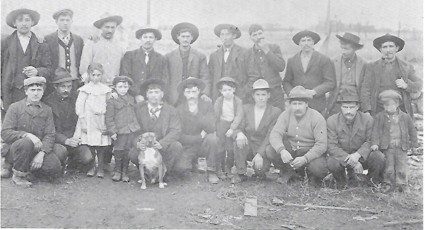
In 1910, the year this photograph was taken, there were over one hundred Italian-American families operating or working on vegetable farms in the valley. On Sundays the families would get together to relax and play such traditional games as bocce ball and non-traditional horseshoes.
The Southern Italians referred to as “Calabrese” although they came from a range of towns and provinces in Southern Italy, formed a neighborhood in the southeast part of Walla Walla where land was less expensive. Braden was the nearest public school, which was often known as the “Italian School,” since a majority of the students were Italian, at one time making up 65 of the school’s 75 students.
One of the largest challenges to immigrant assimilation is the language barrier. Sermons at St. Patrick Catholic Church were delivered only in English. The current St. Francis church, dedicated in 1939, contains among others two beautiful stained-glass windows that read, respectively, “Donated by the Northern Colony,” and “Donated by the Southern Colony,” suggesting which side of the church congregates should sit on in the days the communities still kept separate.
Although these differences persisted for some time, Italians eventually became a unified group in face of a common need to stick together in a foreign land in times of adversity. The establishment of their own produce shipping house in 1916 was an important contributor to this. Italian growers produced a variety of crops, including onions, asparagus, spinach, rhubarb, lettuce, and cabbage. Despite their diverse output, for years they had faced discriminatory practices at established shipping houses in Walla Walla.
The cooperative was founded with 109 original members, all but four of whom were Italian. In addition to serving as a packing house and marketing cooperative, the Walla Walla Gardeners Association served its members as a credit union and a buying club for groceries. Until incorporating in 1983, the WWGA was the oldest shipping cooperative in the West operating under an original charter.
Tensions between Northern and Southern Italians gradually dissipated between the First and Second World Wars. Marriage between the two groups as well as with non-Italians became increasingly acceptable, and differences between Italians and non-Italians lessened.
In addition, second and third generation Italians in Walla Walla began moving off the land, establishing businesses, and attending colleges and universities. As local historian Joe Locati noted, “World War II was the catalyst that bonded all ethnic groups closer together in an all-out effort. Everybody was needed at home. As abroad, all blood lines spilled in the same color.” In America, the melting pot was boiling.
The 1980 census counted 12 million Americans of Italian descent and estimated that one in every 20 Americans is a descendant of Italian immigrants. In Walla Walla, residents of Italian descent have played an important role in the history and development of the entire community over the decades.
More information available from the Italian Heritage Association of Walla Walla at wallawalla.org, and at ww2020.net/history-websites.