
Welcome to the “A Place of Many Paths” History Website
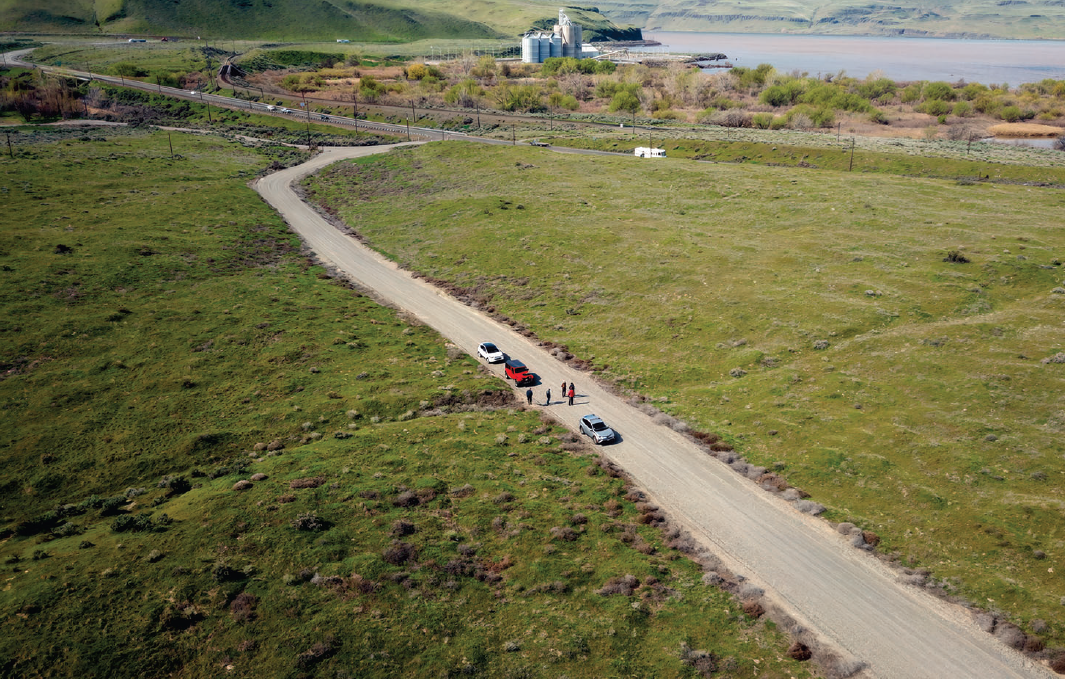 The depression on either side of North Shore Road marks a historically important route that has been used by many peoples. The way was established thousands of years ago by the region’s tribes as part of a vast trail network. The Walla Walla People had a large village nearby, Walúula, which was a center for gathering and trade. From this area, trails extended to Celilo Falls, the Blue Mountains, and beyond.
The crossing of the depression with North Shore Road is 1.5 miles from the site where the North West Company built Fort Nez Percés in 1818. From their gardens and farm located up the Walla Walla River, and later when the Hudson’s Bay Company acquired the Fort in 1822, the road was used to freight stock and produce.
Marcus and Narcissa Whitman used this route to acquire supplies from Fort Nez Percés after establishing their Mission at Waiilatpu in 1836 twenty-five miles to the east. During the 1840s, it was part of the Oregon Trail, and pioneers traveled this road from the mission to the fort. From here they would proceed to the Willamette Valley of Oregon, either by following the Columbia River or by floating down it on rafts and boats.
In 1853, the Longmire and Biles wagon train used this route, but unlike previous trains, they turned northwest when they reached the Columbia River. The wagons were the first to reach the Puget Sound area through Naches Pass. Their pathway, with improvements by Lieutenant Richard Arnold in 1854, was the foundation for the Military Road from Fort Walla Walla to Fort Steilacoom and the Naches Pass Trail.
The military Mullan Road also followed this route. Built between 1858 and 1860 by the US Army, it connected US Army Fort Walla Walla and Fort Benton, Montana. To connect the Missouri River and the Columbia, it had to use the route from Fort Nez Percés up the Walla Walla Valley.
More information on these early-day roads and other historic trails in this area may be found at the Visitors Kiosk just east of here on North Shore Road and also online at www.ww2020.net and www.octa-trails.org.
"A Place of Many Paths" History Panel
Site Sign
Sign placed by Walla Walla 2020c and the Oregon-California Trails Association (OCTA), octa-trails.org.
Invitation to the sign dedication event on August 23, 2026
Additional Resources
Additional information provided courtesy of Sam Pambrun: